How to Manage a Wedding Guest List in India — Complete Guide
Ask any Indian parent who has organised a wedding: the guest list is where the real work happens. Because in Indian families, the guest list is not just a headcount. It is a map of your social relationships, a statement about who matters to your family, and the foundation of the Shagun records you will depend on for the next generation.
Why Indian Wedding Guest Lists Are Uniquely Complex
A standard Western wedding guest list might be 50 to 150 people, all attending one ceremony. An Indian wedding guest list is fundamentally different. You may be managing 300 to 1,000+ contacts, across 4 to 6 different ceremonies, each with different attendance requirements, different Shagun expectations, and different logistical needs.
Step 1: Build the Master Contacts Database
Before you think about who is invited to which ceremony, build your complete master list. Every person your family might consider inviting goes on this list with:
- Full name
- Phone number
- City / location
- Relationship type (immediate family, relative, family friend, colleague, neighbour)
- Family branch (maternal, paternal, in-laws, bride’s side, groom’s side)
- Head of household (for families where one invite covers the whole family)
This master list is your contacts database. From it, you will draw the ceremony-specific invitation lists.
Step 2: Create Ceremony-Wise Guest Sub-Lists
| Ceremony | Typical Guest Count | Notes |
|---|---|---|
| Haldi | 20–50 | Close family only, intimate |
| Mehendi | 30–100 | Female family and close friends |
| Sangeet | 100–300+ | Extended family and friends |
| Wedding (Shadi) | 300–800+ | Full invitation list |
| Reception | Sometimes larger | Colleagues and extended network |
Each ceremony should be treated as a separate event with its own list, its own invitations, and its own RSVPs.
Step 3: RSVP Tracking
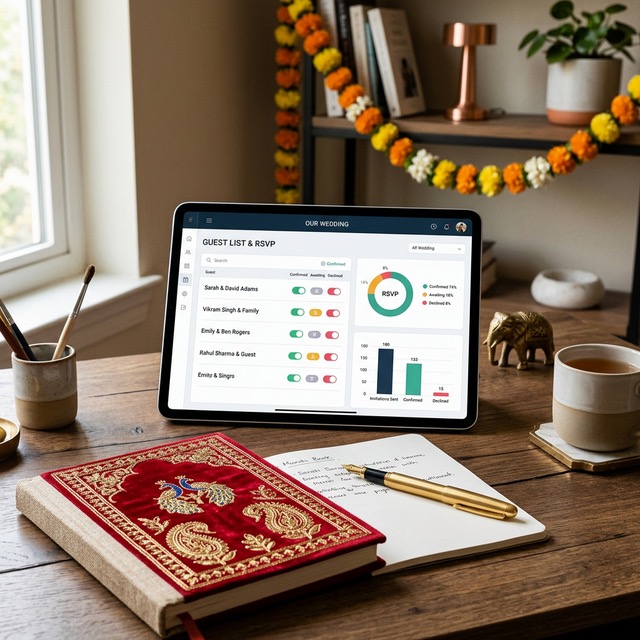
For each guest on each ceremony list, track one of three statuses:
- Confirmed — will attend
- Declined — will not attend
- Pending — no response yet
As the ceremony date approaches, call the Pending group directly. Confirm headcount with the caterer 10 to 14 days before each event.
Common mistake: Many families track RSVPs in a WhatsApp group or a single Excel sheet. This becomes unmanageable once you have 200+ guests across multiple ceremonies. A dedicated system with per-ceremony tracking is worth the extra effort.
Step 4: Set Up the Shagun Recording System
For every ceremony where Shagun is given, you need a designated Munshi and a recording system:
- Station at the gift table — set up near the entrance, visible to incoming guests
- Record every entry — for each guest who gives Shagun: note their name, relationship, and exact amount
- Handle cash systematically — keep envelopes with their recorded amounts together
- Record digital Shagun separately — UPI and bank transfers received during the event should be noted in real time
Step 5: Post-Event Reconciliation
After each ceremony, consolidate the Shagun records into the family’s master ledger. This is critical — the master ledger is what your family will consult for the next 20 years when deciding how much to give at future events.
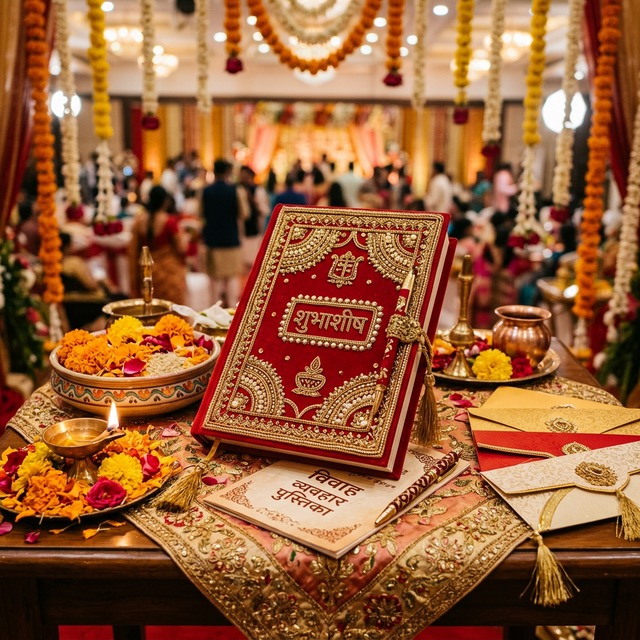
The traditional Vyavahar Book (Red Notebook) was this master ledger. Today, Nyota serves this purpose digitally — linking each Shagun record to the specific contact, event, and amount.
📱 The Complete Wedding Guest Management App Build your contact database, create ceremony-wise guest lists, track RSVPs, and record Shagun — all in Nyota, built specifically for Indian family events. Download free at thenyota.app →
The Guest List Is Your Family’s Social Map
Every person on your wedding guest list represents a relationship that your family has cultivated over years or decades. Managing the list well is an act of respect for all of those relationships.
Learn More: Read our guide to Traditional Indian Wedding Invitation Customs →
Enjoyed this article?
Download Nyota to experience the modern way of gifting yourself.