Difference Between Roka and Engagement in Indian Weddings
If you have recently heard that a family’s son or daughter is getting married, you may have heard both terms — “Roka ho gaya” and “Sagai ka date aa gayi.” The two events are related but distinct. Understanding the difference helps you know when to attend, what to bring, and what each moment means.
The Direct Answer
Roka is an informal private agreement between families — no rings, close family only, small gathering. Engagement (Sagai) is a formal public ceremony with ring exchange, blessings from extended family, and often a dinner celebration. Roka always comes before Engagement.
Roka: The Private Commitment
The word Roka (रोका) comes from “rokna” — to stop. When a Roka happens, both families agree: we are stopping the search. We have found the right match for our child.
The Roka is not a celebration for the world — it is a commitment between two families. Typically held at the girl’s home, with only the closest family present — parents, siblings, and perhaps grandparents and one or two close aunts and uncles. Total attendees: often 10 to 30 people.
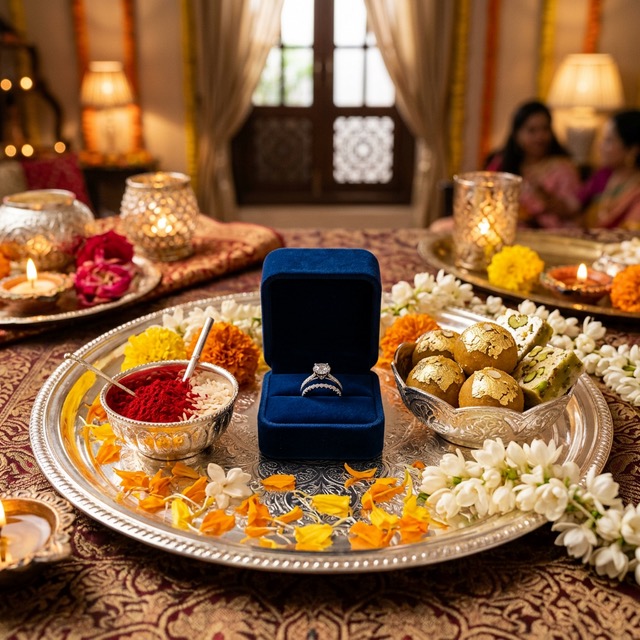
The ritual is simple: the girl’s family applies a tilak to the boy’s forehead, sweets are shared, and a small Shagun is exchanged. No ring exchange, no pandit in most traditions.
Engagement / Sagai: The Public Declaration
The Sagai is the Roka’s public counterpart. What the Roka settled privately, the Sagai announces publicly. It is a formal ceremony — led by a pandit in many families — where the couple exchanges rings in front of extended family and friends.
Sagai is a gathering of 50 to 200+ people. Both families come together with their extended networks. Shagun is given generously — this is the first major Shagun event of the wedding cycle for most relationships.
Key Differences at a Glance
| Aspect | Roka | Engagement (Sagai) |
|---|---|---|
| Formality | Informal, private | Formal, public |
| Guest count | 10–30 close family | 50–200+ guests |
| Rings | No rings | Ring exchange |
| Pandit | Usually not required | Often present |
| Shagun | Small, close family only | Full Shagun from all guests |
| Order | First | Second |
Can You Skip One of Them?
Yes — many families do. Some skip the Roka entirely and go directly to Sagai. Others combine both into a single ceremony. What matters is that both families have genuinely agreed to the match before the engagement happens.
What to Bring to Each Ceremony
For Roka: Close family typically brings sweets, dry fruits, and a small Shagun (₹501–₹2,001 is typical).
For Sagai: Bring a standard Shagun appropriate to your relationship. Physical gifts — jewellery, silver items — are appropriate for close family. The Sagai is the first time the full Shagun ledger opens.
📱 Create Separate Events for Roka and Sagai Each ceremony has its own guest list and Shagun records. Nyota lets you manage them separately. Download free at thenyota.app →
The Emotional Difference
Beyond the logistics, Roka and Sagai carry very different emotional tones. The Roka is quiet, certain, and intimate — a moment between families that will be remembered privately. The Sagai is public, celebratory, and outward-facing — a performance of joy for the community.
Both are necessary. The private certainty of Roka makes the public joy of Sagai genuine.
Learn More: Read our guide to What Happens in the Haldi Ceremony →
Enjoyed this article?
Download Nyota to experience the modern way of gifting yourself.