What is a Vyavahar Book? India's Wedding Gift Diary, Explained
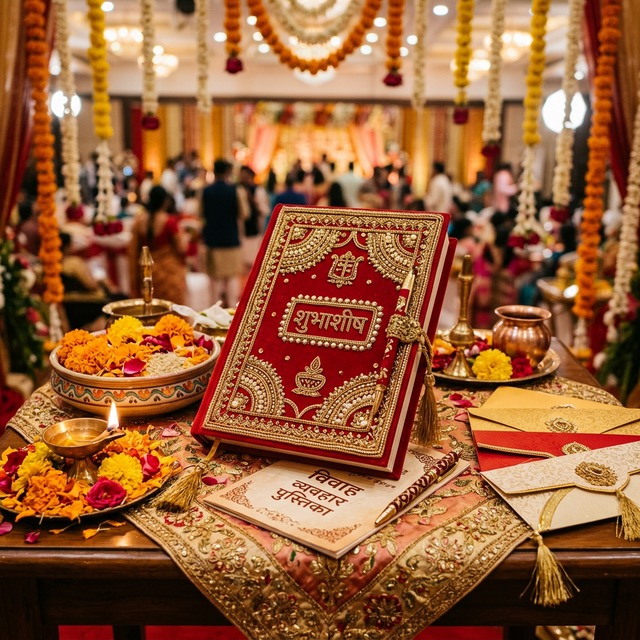
Walk into any North Indian wedding and you will find it — a worn diary, sometimes wrapped in cloth, sitting on a table near the entrance. A family elder or a hired Munshi sits beside it, pen in hand, recording the name of every guest who arrives and the amount they present as Shagun.
That diary has a name. It is called the Vyavahar Book (व्यवहार बुक) — and for generations, it has been the financial memory of the Indian family.
📖 In this article
What a Vyavahar Book is · Why families keep it · How Shagun recording works · The problems with paper records · How digital tools like Nyota are replacing it
What Does “Vyavahar” Mean?
Vyavahar (व्यवहार) is a Sanskrit-derived Hindi word that means dealings, conduct, or transactions — specifically the social and financial exchange between people. In the context of Indian family life, it refers to the tradition of giving and receiving gifts at ceremonies.
The Vyavahar Book is therefore the book of dealings — a record of every gift given and received, who gave it, at which event, and what the relationship is to the family. It is the original Indian ledger of social obligation and gratitude.
In different regions of India, it is known by different names:
- Vyavahar Book — most common in UP, Bihar, Rajasthan, MP
- Red Notebook or Lal Diary — descriptive name based on the red cover used by many families
- Shagun Book — named after Shagun, the auspicious gift given at ceremonies
- Nehta Book — used in some communities
- Gift Register — the anglicised version used by urban families
Whatever the name, the function is the same: to create a permanent record of who gave what, so the family can reciprocate correctly in the future.
How Does a Vyavahar Book Work?
At most Indian weddings and family ceremonies, a designated person sits at a table near the entrance of the venue. Guests approach, offer their Shagun (usually cash in an envelope, though jewellery and other gifts are also common), and the recorder writes down:
- The guest’s full name
- Their village or city
- Their relationship to the family (uncle, maternal aunt, neighbour, etc.)
- The amount or description of the gift
- Sometimes, a note about what the family gave at a previous ceremony
This person — often called the Munshi — is trusted with one of the most important jobs at the event. Entries must be legible, accurate, and complete. In large weddings with hundreds of guests, the Munshi may be recording entries continuously for eight to twelve hours across multiple days.
The Vyavahar Book is not just a financial record — it is a map of the family’s social world. Every entry represents a relationship, an obligation, and a memory.
— A tradition passed through generations in Indian households
What is Shagun?
Shagun (शगुन) is the auspicious gift presented at a ceremony to bless the hosts and mark participation in the celebration. It is one of the most important social customs in North Indian culture.
Shagun is almost always given in cash — typically in amounts that carry cultural meaning. Odd numbers ending in ₹1 are considered auspicious: ₹101, ₹501, ₹1,001, ₹2,100, ₹5,100. The ₹1 added to a round number is said to represent a blessing and a continuation — the gesture of giving more than a complete amount.
💡 Why Odd Amounts?
The tradition of giving Shagun in odd amounts (₹101, ₹501, ₹1,001) comes from the belief that odd numbers are open-ended and represent continuation and good fortune, unlike even numbers which are considered complete and closed. The ₹1 at the end is the “ashirvaad” — the blessing.
Shagun is not simply a gift — it is a social contract. When you give ₹2,100 at someone’s wedding, there is an implicit expectation that they will give a comparable or greater amount at your own family’s future events. The Vyavahar Book is what makes this system work across years and decades.
Why is the Vyavahar Book So Important?
To an outsider, tracking who gave what at a wedding might seem like unnecessary record-keeping. But in the context of Indian family life, the Vyavahar Book is essential for several reasons.
1. Reciprocity is a Social Obligation
Indian gift culture runs on reciprocity. If a family gives generously at your event, failing to match or exceed that generosity at their events is considered disrespectful — regardless of how many years have passed. The Vyavahar Book is the reference that ensures no family is accidentally dishonoured.
2. Events Span Generations
A family patriarch may remember that when his sister’s son got married twenty years ago, the family gave ₹3,100. Now that patriarch’s own son is getting married and the same cousin’s family will attend. The Vyavahar Book from twenty years ago is the reference for what should be given now.
3. Ceremonies Involve Hundreds of Relationships
A typical North Indian wedding involves family from multiple generations, multiple sides of two families, neighbours, colleagues, community members, and sometimes guests the hosts have never met personally. Without a systematic record, tracking who came and what they gave becomes impossible after the event ends.
4. Financial Settlement Needs Accurate Records
After the event, the family needs to reconcile what was received against the costs of the wedding. The Vyavahar Book is the primary source for this settlement — knowing the total Shagun collected helps cover expenses and clear debts.
📊 Scale of a Typical Indian Wedding
A mid-size North Indian wedding typically has 300–800 guests across 2–4 ceremonies. If average Shagun is ₹1,500 per family unit, and families average 2 members attending, a 500-guest wedding collects approximately ₹3.75–₹5 lakh in Shagun. Without the Vyavahar Book, this cannot be tracked accurately.
The Problems with Paper Vyavahar Books
For all its cultural importance, the paper Vyavahar Book has significant limitations that cause real problems for families every year.
| Problem | What Goes Wrong |
|---|---|
| Illegible handwriting | Under pressure, the Munshi writes fast. Entries become unreadable within months. |
| Lost books | A book from 1998 is irreplaceable. Families routinely lose records during moves, floods, or simply misplacement. |
| No search | Finding a specific person’s entry in a handwritten book with 400 names requires reading every line. |
| No totals | Summing Shagun amounts requires manual addition — slow and error-prone during the event. |
| Duplicate entries | When multiple people manage the book across a multi-day wedding, duplicates and gaps appear. |
| No history linking | The 2026 book has no connection to the 2018 book — a family must physically locate and compare both. |
| Single point of failure | If the Munshi is absent, or the book is misplaced on the day, everything stops. |
These are not minor inconveniences. Families have lost decades of relationship history because a single notebook deteriorated or was lost. The cultural cost of that loss — not knowing what you owe, not knowing what was given — is significant.
How Digital Tools Are Replacing the Vyavahar Book
Over the past few years, Indian families — particularly younger generations helping their parents organise events — have begun looking for digital alternatives to the paper Vyavahar Book.
The ideal digital replacement needs to do exactly what the paper book does, but faster, more accurately, and without the risk of loss:
- Record guest names, relationships, and Shagun amounts quickly
- Work offline in wedding venues with poor connectivity
- Calculate totals automatically
- Be searchable by name, city, or relationship
- Link to a history of previous events
- Export to PDF or Excel for final settlement
- Be secure and private — family financial records are not for sharing
This is exactly the gap that Nyota was built to fill.
📱 Try Nyota Free
Nyota is free for personal use on both Android and iOS. Create your first event, add your guest list, and experience the Digital Vyavahar Book before your next family celebration. Download at thenyota.app →
How Nyota Replaces the Vyavahar Book
Nyota was designed from the ground up for Indian families and their events. It is not a generic guest list tool — every feature is shaped around how Indian ceremonies actually work.
Desk Mode — Built for the Munshi
Nyota’s Desk Mode is designed for rapid entry at a reception desk. A large numeric keypad allows the Munshi to enter Shagun amounts in under three seconds per guest. Guest names auto-suggest from the existing contact list. The family never needs to slow down the line.
Relationship History — The Digital Memory
When a guest’s name is entered, Nyota instantly shows what that person gave at previous events. The Munshi — or the family elder reviewing records — can immediately see the relationship history that the old paper Vyavahar Book used to hold.
Event Management — Beyond Shagun
Nyota also handles the full event management layer: guest lists, RSVPs, event schedules, team roles (so multiple family members can help manage the same event), and event activities. Everything the family needs for one ceremony is in one place.
Export — For Settlement
After the event, Nyota generates a complete PDF or Excel export of all Shagun received — ready to share with the family elder, the accountant, or anyone who needs the final numbers.
Conclusion: A Tradition Worth Preserving Properly
The Vyavahar Book is one of India’s most quietly important cultural institutions. It holds the financial memory of the family — who came, what they gave, and what is owed in return. For generations, it was kept in a red diary passed from elder to elder.
That tradition deserves to be preserved. Not abandoned — but upgraded. The relationships and obligations it records are real and meaningful. What should change is the medium.
A digital Vyavahar Book never fades, never gets lost, is instantly searchable, calculates totals automatically, and links your family’s history across decades of events. That is what Nyota is built to be.
📱 Try Nyota Free
Nyota is free for personal use on both Android and iOS. Create your first event, add your guest list, and experience the Digital Vyavahar Book before your next family celebration. Download at thenyota.app →
Learn More: Read our complete guide to Wedding Shagun — traditions, amounts, and how to track every gift →.
Enjoyed this article?
Download Nyota to experience the modern way of gifting yourself.