Traditional Indian Wedding Invitation Customs — The Complete Guide
In most parts of the world, an invitation is something you receive in the mail or by email. You note the date. You respond. You attend. In Indian wedding culture, the invitation process is considerably more layered — and considerably more meaningful.
The act of giving an invitation (nimantran dena) is itself a ceremony. How you deliver it, to whom you deliver it personally, what you bring with you, and what you say when you do — all of these carry social weight that the printed card alone cannot convey.
Why the Indian Wedding Invitation Is Different
The difference between Indian and Western invitation culture comes down to one thing: in Indian tradition, you do not inform people about your wedding — you request the honour of their presence. These are meaningfully different social acts.
Informing someone assumes they will decide whether to come based on their schedule. Requesting their presence acknowledges that their attendance is a gift to your family — and that the invitation itself is an act of honour extended to them.
The Card Itself: Design and Content Conventions
Ganesha Is Always First
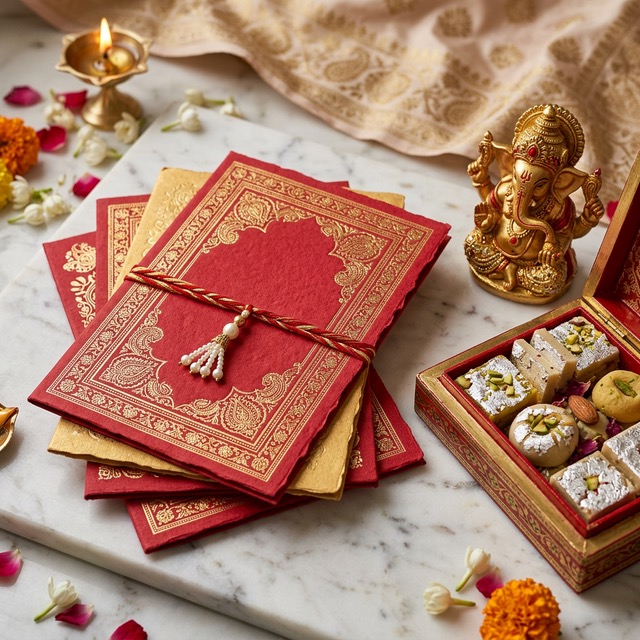
Open any traditional Hindu wedding card and the first thing you see is Lord Ganesha — the remover of obstacles and the lord of new beginnings. Ganesha’s image at the top of the card is non-negotiable in most Hindu traditions.
The Voice of the Card
Indian wedding cards are almost universally written in the voice of the parents, not the couple:
“Shri and Smt. [Bride’s Father’s Name] request the honour of your presence at the marriage of their daughter [Bride’s Name] with [Groom’s Name], son of Shri and Smt. [Groom’s Father’s Name]…”
This reflects the fundamental nature of Indian weddings as family events, not just the couple’s personal celebration.
Auspicious Colours
| Colour | Significance |
|---|---|
| Red | The colour of auspiciousness, marriage, and sindoor |
| Gold | Prosperity and the warmth of celebration |
| Cream / ivory | Elegant backgrounds that make red and gold pop |
| Saffron / orange | Spiritual energy and celebration |
Avoid: white (mourning in most Hindu communities), black, and grey.
What the Card Must Include
- Lord Ganesha image or symbol
- Names of both sets of parents (as hosts)
- The couple’s full names
- Wedding date and muhurat time
- Venue name and full address
- All ceremony details — Mehendi, Haldi, Sangeet, Wedding, Reception — with dates, times, and venues
- RSVP contact number
- For out-of-station guests: hotel recommendations or accommodation information
The Art of Personal Invitation Delivery
For senior relatives — grandparents, maternal and paternal uncles and aunts, and the family’s closest friends — a personal visit is expected, not optional. The invitation delivery visit follows a gentle protocol:
- Bring sweets — a box of mithai accompanies every invitation visit to a senior relative
- Bring the right people — for very senior relatives, the parents themselves should make the visit
- The verbal request — look at the elder and say: “Aap ko bulane aaye hain — please zaroor aaiye” (We have come to invite you — please do come)
- Stay for tea — a brief visit of 20 to 40 minutes is appropriate; leaving immediately after delivering the card is rude
The Hierarchy of Invitation Delivery
| Tier | Who | How |
|---|---|---|
| Tier 1 | Grandparents, senior relatives, lifelong family friends | Personal visit with parents |
| Tier 2 | Cousins, family friends of parents’ generation | Personal visit without parents |
| Tier 3 | Outstation relatives | Posted or couriered card with a personal phone call |
| Tier 4 | Colleagues, acquaintances, wider network | Digital invitation via WhatsApp |
When to Send Invitations
- 6 to 8 weeks before: Begin distributing physical cards to Tier 1 and Tier 2 guests
- 4 to 6 weeks before: Post cards to outstation relatives
- 2 to 3 weeks before: Send digital invitations to the wider network
- 1 week before: Send reminder messages with final details — venue map, parking, schedule confirmation
The Modern Indian Wedding Invitation
Contemporary Indian wedding invitations have evolved dramatically. Many urban families now combine the traditional physical card with a beautifully designed digital invitation — animated WhatsApp invitations are now genuinely mainstream.
However, the digital invitation has not replaced personal delivery for senior relatives and close family. In fact, many families report that personal visits have become more meaningful precisely because the rest of the communication has gone digital. The personal visit stands out as a gesture of genuine respect.
📱 Track Who Has Been Invited and Who Has RSVPed Nyota stores your full contacts database with ceremony-wise guest lists and RSVP tracking. Know exactly who has been invited and what Shagun they have given — all in one organised app. Download free at thenyota.app →
The Invitation That Starts a Relationship
In Indian culture, receiving a wedding invitation is a statement: you are part of our world, we want you present at our most important moment, and we are willing to come to your door to say so.
Delivering that invitation with the care, warmth, and personal attention that tradition calls for sets the tone for the relationship that continues after the wedding.
Learn More: Read our complete guide to What Is a Vyavahar Book? →
Enjoyed this article?
Download Nyota to experience the modern way of gifting yourself.