Shagun Ceremony Meaning — What It Is & Why It Matters in Indian Culture
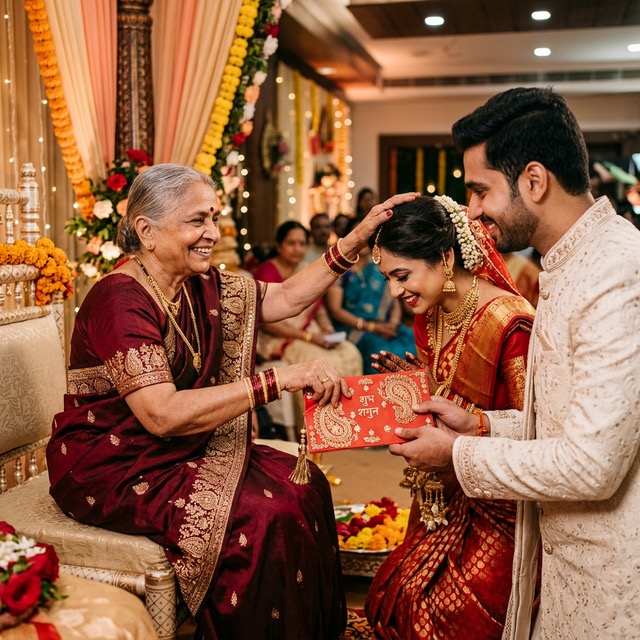
At every Indian wedding, there is a moment — often amid the music and colour — when an elder quietly approaches the couple, places a hand on their heads, and tucks a red envelope into their hands. This is Shagun. And while it looks like a simple act of gifting, it is carrying centuries of meaning.
What Does “Shagun” Mean?
Shagun (शगुन) comes from Sanskrit — a compound of “sha” (auspicious, blessed) and “gun” (quality, virtue). An auspicious quality. A blessed omen. When someone says “Shagun dena” (give Shagun), they are not just saying “give a gift” — they are saying “offer a blessing through a gift.”
This distinction matters. In Western gifting culture, a gift is primarily an object — its value is in what it is. In Indian Shagun culture, the gift is primarily a blessing — its value is in what it represents: your goodwill, your relationship, and your investment in the recipient’s prosperity.
When Is Shagun Given?
Shagun is not exclusive to weddings. It is the standard gifting form for any significant life event:
- Roka and Engagement — families begin Shagun exchange when the match is agreed upon
- Wedding ceremonies — the primary Shagun occasion across all pre-wedding and wedding events
- Griha Pravesh (housewarming) — guests bring Shagun to bless the new home
- Baby ceremonies (Naamkaran, Mundan) — Shagun is given to bless the child
- Festivals — during Diwali and Holi, elders give Shagun to younger family members
- Milestone birthdays — significant birthdays (1st, 25th, 50th)
The Ritual Elements of a Shagun Ceremony
A Shagun ceremony is not just handing over an envelope. It follows a gentle, emotionally layered ritual:
- The approach — the guest or elder approaches the couple or host family
- The blessing — the elder places their hand on the head or cheek of the recipient — the physical act of transferring the blessing
- The presentation — the Shagun envelope or gift is placed in the recipient’s hands, often with words: “Khush raho” (be happy), “Phalo-phulo” (prosper)
- The recording — a family member — traditionally the Munshi — notes the giver’s name, their relationship, and the exact amount in the family register (Vyavahar Book)
That fourth step — the recording — is what transforms Shagun from a one-time gift into a long-running social contract.
The Munshi: The Person Who Holds It All Together
In traditional Indian weddings, the Munshi (notebook keeper) is one of the most important people in the room. Usually a trusted family member, they sit near the Shagun table with the Vyavahar Book (Red Notebook), recording every gift.
The Munshi’s record is the foundation of the family’s reciprocal giving for the next generation. When a cousin hosts a wedding five years later, the family opens the notebook and checks: what did their family give us? What should we give in return?
📱 The Modern Munshi — Nyota Track cash and digital Shagun in one place. Record gifts per guest, per event. Build the ledger your family will rely on for the next generation. Download free at thenyota.app →
Shagun as a Living Ledger
The most profound aspect of Shagun is that it is never “finished.” Every gift given creates an obligation — not a burden, but a bond. When you give Shagun at a wedding, you are entering a relationship of mutual support that extends into the future.
This is why the ₹1 is always added to the total — the odd number ensures the account stays open. The relationship cannot be “settled” because it is not meant to be. It is meant to continue, to grow, to span generations.
Shagun in Modern Times
In the era of UPI payments and digital weddings, Shagun has adapted without losing its essence. Families now send digital Shagun to out-of-city relatives. “Shagun for Rahul and Priya’s wedding — with blessings” arrives via bank transfer. The blessing still travels with the money, even through a banking app.
What has become harder to maintain is the record. This is why a dedicated Shagun tracking system — whether a traditional Vyavahar Book or a modern app — remains as important as ever.
The Gift That Is Also a Promise
Shagun is, at its core, a promise. The money is almost secondary. The real content of a Shagun envelope is: “I see this event as important. I see your family as part of my world. I will be here when you need me, and I trust you will be there when I need you.”
That is why the ceremony matters — and why recording it faithfully honours the spirit of the tradition.
Learn More: Read our guide to Shagun Gift Ideas for Weddings →
Enjoyed this article?
Download Nyota to experience the modern way of gifting yourself.