How Much Shagun to Give at a Wedding in India — A Complete Guide
You have been invited to a wedding. You are happy to attend — and completely unsure how much to put in the Shagun envelope. Too little feels stingy. Too much feels like showing off. And no one ever gives you a number.
This guide breaks down exactly what to give, by relationship and by occasion, so you can arrive confident and give generously without second-guessing yourself.
The Core Principle: Shagun Is Reciprocal
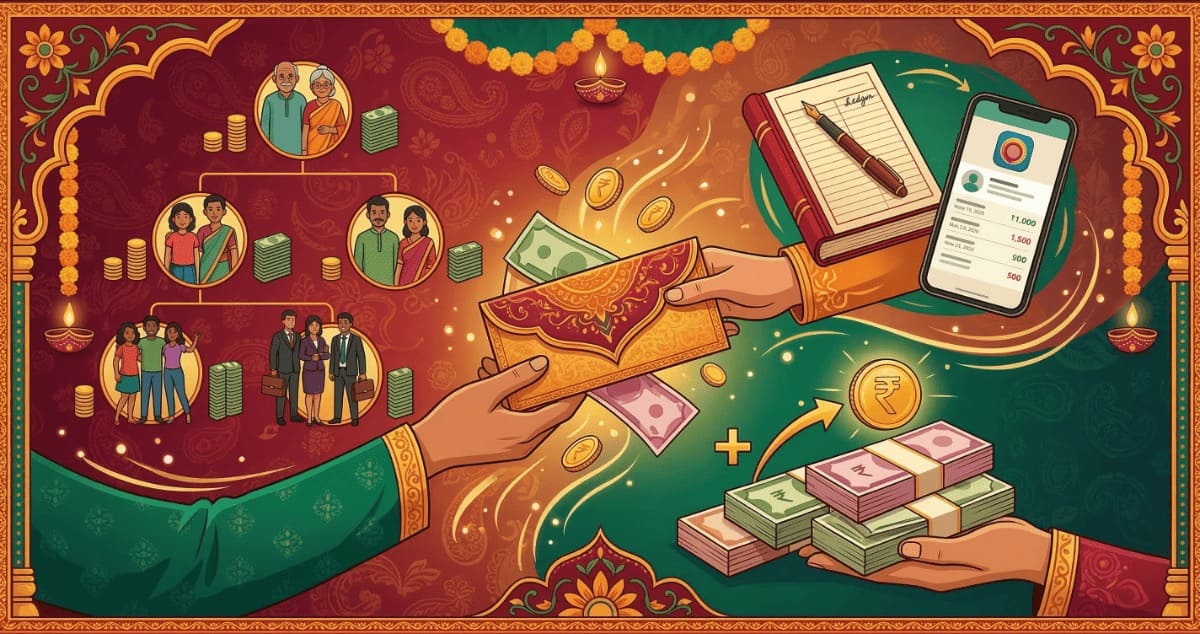
Before looking at any table of amounts, understand the underlying logic. Shagun is not a donation — it is a reciprocal exchange. Indian families maintain an informal ledger across generations: you give at their wedding; they give at yours. The amount you give today is roughly what you can expect to receive when your family hosts an event.
This means the question is not just “how much is appropriate” but also “what do I want to establish as the norm in this relationship?”
Shagun Amount by Relationship — Reference Table
| Relationship | Typical Shagun Range | Notes |
|---|---|---|
| Parents (to their child) | ₹11,001 – ₹1,00,001+ | Often includes gold, jewellery |
| Siblings | ₹5,001 – ₹51,001 | Varies by family wealth |
| Maternal / paternal uncles (Mama, Chacha, Fufa) | ₹5,001 – ₹25,001 | Higher for close uncles at main wedding |
| Aunts (Maami, Chachi, Bua) | ₹2,001 – ₹11,001 | May give gifts alongside cash |
| First cousins | ₹1,001 – ₹5,001 | Peer-group gifting, often matching |
| Extended / distant relatives | ₹501 – ₹2,001 | Standard acknowledgement amount |
| Close family friends | ₹1,001 – ₹5,001 | Depends on closeness and history |
| Colleagues (work) | ₹501 – ₹1,001 | Often collective gifting in offices |
| Neighbours | ₹501 – ₹1,001 | Warm gesture, not expected to be large |
| Distant acquaintances | ₹101 – ₹501 | Minimum auspicious acknowledgement |
Always add ₹1. Whatever amount you decide, make it odd: ₹501 not ₹500, ₹2,001 not ₹2,000. The extra rupee is the tradition that marks the gift as auspicious and the relationship as ongoing. Read our guide to Why Is ₹1 Added in Shagun? The Real Reason Behind the Extra Rupee →
How City and Region Affect the Amount
Shagun amounts vary significantly by geography. In metro cities — Delhi, Mumbai, Bengaluru, Hyderabad — event costs are high and gifting norms have adjusted. ₹501 from a close relative at a Delhi wedding would be noticed as low.
North Indian communities (Punjabi, Rajasthani, UP, Haryana) tend to have higher Shagun norms and stronger reciprocity expectations. South Indian communities have different conventions — amounts vary by community. If you are unsure of regional conventions, ask a family elder discreetly.
The “What Did They Give Us?” Factor
The most honest guide: check what the family gave at your last event. If they gave ₹5,001 at your daughter’s wedding three years ago, giving ₹1,001 at their son’s wedding today would be a social step down that will be noticed.
This is precisely why the Vyavahar Book — and its modern digital equivalent — matters so much. Families who kept meticulous Shagun records could look up exactly what every relationship had given and received, and respond with perfect reciprocal grace.
📱 Know Your Shagun History with Nyota Nyota stores your Shagun history per contact across all events — so you always know the reciprocal context before giving. Download free at thenyota.app →
When Shagun Goes Beyond Cash
For close family — parents, siblings, and close relatives — Shagun often includes physical gifts alongside or instead of cash. Gold jewellery, silver items, and household goods are all part of Indian wedding gifting vocabulary.
When giving both cash and a physical gift, the cash component should still follow the odd-number rule. A gold necklace plus ₹1,001 cash is a complete Shagun.
Group Gifting: Office and Friend Collections
In offices and friend groups, it is common to pool money for a single Shagun. When collecting from colleagues, a standard practice is to set a per-person contribution of ₹200–₹500 and consolidate into one envelope. The total pooled amount should still be an odd number — the organiser typically adds ₹1 at the end before sealing.
What If You Cannot Afford the “Expected” Amount?
Financial constraints are real and families understand this. The grace move is to give what you can — even ₹501 with a heartfelt personal blessing — rather than avoid attending. No genuine relationship is measured purely by Shagun amounts.
A ₹501 envelope handed with warmth and a genuine blessing for the couple outweighs a larger amount given with indifference.
Getting the Amount Right Is an Act of Respect
Shagun etiquette is not about impressing anyone — it is about honouring a relationship in a way the other family will recognise. The right amount tells them: I know how close we are, I respect our history, and I am investing in our future.
Use the table in this guide as a starting point. Ask an elder if you are unsure. Check what was given at your last event. And always — always — add that extra rupee.
Learn More: Read our guide to Shagun Amount for Weddings Across India →
Enjoyed this article?
Download Nyota to experience the modern way of gifting yourself.